8 Reasons Marketing Teams Are Migrating from WordPress to Drupal
Table of Contents
- Summary
- Drupal’s Position in the Enterprise CMS Landscape
- Drupal versus WordPress: Marketing Capability Comparison
- 1. More Marketing Control, With Less Developer Dependency
- 2. Structured Content That Can Be Reused Everywhere
- 3. Reusable Components Without Losing Brand Consistency
- 4. Better Workflows for Larger Marketing Teams
- 5. Centralized Control Across Multiple Sites and Teams
- 6. A Stronger Foundation for Marketing Automation and Integrations
- 7. Better Prepared for AI-Driven Content and Discovery
- 8. You Don’t Have to Wait Until You’re an Enterprise to Choose Drupal
- Should Your Marketing Team Migrate from WordPress to Drupal?
- Final Takeaway: Choose for the Marketing Operation You’re Building

Summary
Why are marketing teams migrating from WordPress to Drupal? As marketing operations grow, teams need more than simple page publishing. They need structured content, reusable components, governed workflows, multiple-site management, marketing automation, enterprise integrations, and reliable foundations for AI.
WordPress remains widely used, particularly among smaller organizations, but Drupal has a stronger concentration among mid-market companies, large enterprises, governments, nonprofits, financial institutions, healthcare organizations, and other complex environments. Drupal is designed to manage sophisticated content and publishing requirements without relying as heavily on extensions and one-off customizations.
For marketing teams, Drupal provides eight key advantages: greater autonomy, structured content, reusable components, stronger editorial workflows, centralized multisite governance, deeper marketing integrations, AI-ready content architecture, and a platform that can scale from mid-market to enterprise requirements.
Back to topDrupal’s Position in the Enterprise CMS Landscape
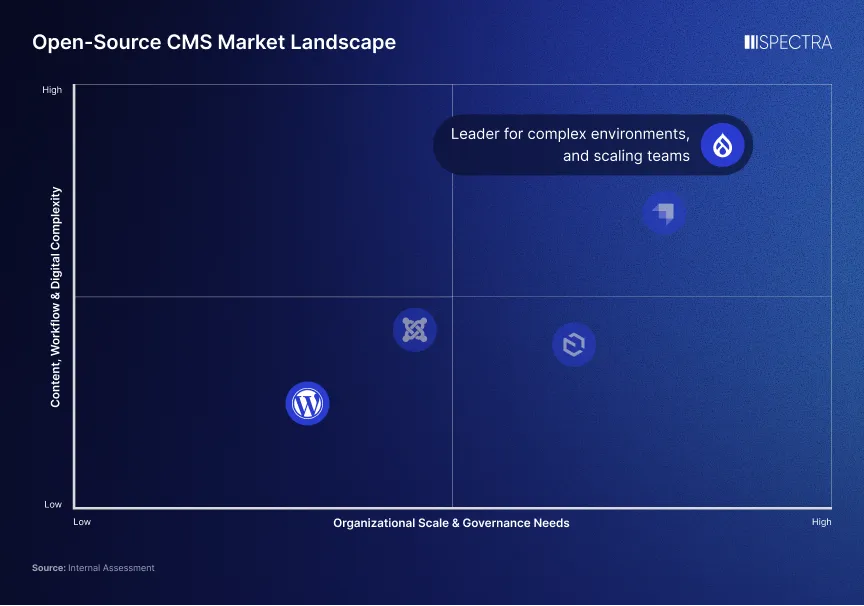
WordPress dominates by website volume, but Drupal is far more concentrated among mid-market and larger organizations. Among organizations with known company size, 27.5% of Drupal users have 51 employees to 1,001+ employees, compared with 11.3% of WordPress users.
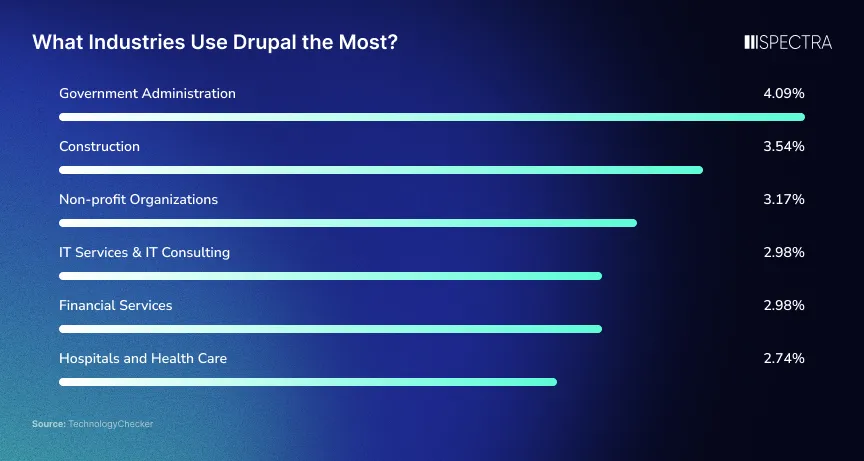
Drupal also has a distinctly institutional profile. TechnologyChecker reports that 14.61% of Drupal organizations were founded before 1960, the highest concentration among the platforms it tracks. Government is Drupal’s largest detected industry, with strong representation across nonprofits, financial services, healthcare, universities, and major enterprises.
Drupal’s smaller website count should therefore be viewed in context. BuiltWith detects 398,394 live Drupal websites worldwide, but a single Drupal platform can support multiple brands, markets, departments, products, languages, and digital services.
Now Drupal is extending that foundation further into the mid-market, supported by the Drupal CMS Strategy 2026 initiative. Drupal CMS is being designed to be easier for marketing teams to adopt earlier, while retaining the structured content, governance, integrations, and scalability associated with larger implementations.
The question is no longer simply WordPress or Drupal? It is whether your organization is ready to adopt a stronger marketing infrastructure built for scale, governance, and long-term growth.
Back to topDrupal versus WordPress: Marketing Capability Comparison
WordPress is highly extensible, but sophisticated marketing environments often require additional plugins, configuration, and custom development. Drupal is architected more naturally for complex digital platforms, where structured content, governance, workflows, multiple teams, integrations, and reuse are fundamental requirements rather than later additions. Drupal core itself includes JSON and advanced content-management architecture, while Drupal CMS adds a marketer-facing visual layer through Canvas and other packaged capabilities.
| Marketing Capability | Drupal | WordPress |
| Launching a modern marketing website | Yes | Yes |
| Building pages with less developer support | Yes | Yes |
| Rebranding without rebuilding the platform | Yes | Yes |
| Managing a growing internal marketing team | Yes | No |
| Using AI to build and configure site pages | Yes | No |
| Using AI to create and improve web content | Yes | No |
| Using AI to improve search and findability | Yes | No |
| Scaling across larger marketing team needs | Yes | No |
| Publishing new reusable components quickly | Yes | No |
| Making iterative enhancements without debt | Yes | No |
| Keeping time to market fast through growth | Yes | No |
| Managing updates and security with control | Yes | No |
| Running multiple brands, markets and sites | Yes | No |
| Coordinating publishing workflows at scale | Yes | No |
| Scaling content and integration operations | Yes | No |
Drupal's commitment to marketing also extends beyond the CMS itself. In 2019, Acquia, co-founded by Drupal creator Dries Buytaert, acquired Mautic, the open-source marketing automation platform. The stated ambition was to combine Drupal-powered digital experiences with open marketing automation across channels such as email and personalized campaigns.
That history matters because it reflects the direction set out in the Drupal CMS Strategy 2026, which focuses on making Drupal easier for marketers to use out of the box through pre-configured recipes, AI-assisted site building, and a more opinionated, marketer-first experience.
For sophisticated marketing operations, Drupal is not simply a CMS that can be extended until it fits. Much of the architecture marketing teams eventually need is already part of the foundation, which translates into faster time to market.
Back to top1. More Marketing Control, With Less Developer Dependency
Where WordPress starts to become challenging
WordPress gives marketers flexibility, but that flexibility can become fragmented as the website grows. New campaigns often require calculators, comparison tools, or custom lead flows, and each need is typically solved through additional plugins, custom builds, or development handoffs. Over time, this creates a simple operational reality: marketing moves at the speed of the website backlog.
WordPress itself relies heavily on plugins to extend functionality, and its security guidance highlights the need to continuously update WordPress core, themes, and plugins because extensions can introduce additional maintenance and risk. The issue is not the plugins themselves, but rather the accumulation of dependencies when key marketing capabilities are distributed across many separately maintained extensions and customizations.
Where Drupal excels
Drupal is better suited to turning recurring marketing requests into reusable platform capabilities, where development can build and approve a component once and make it available across product pages, campaigns, and even different sites. This means that when marketing requests something like a new product comparison experience, it doesn’t need to be rebuilt each time, it becomes a shared building block that can be reused across different contexts. The same model can apply to:
- promotional banners and campaign blocks,
- forms and lead-generation experiences,
- product cards and comparison tables,
- calculators, FAQs, and calls to action.
Drupal Canvas is designed specifically around this model. Drupal says Canvas allows content creators to compose pages without relying on developers, while Drupal CMS 2.0 makes it the default visual editing experience with drag-and-drop components, live previews, and real-time editing.
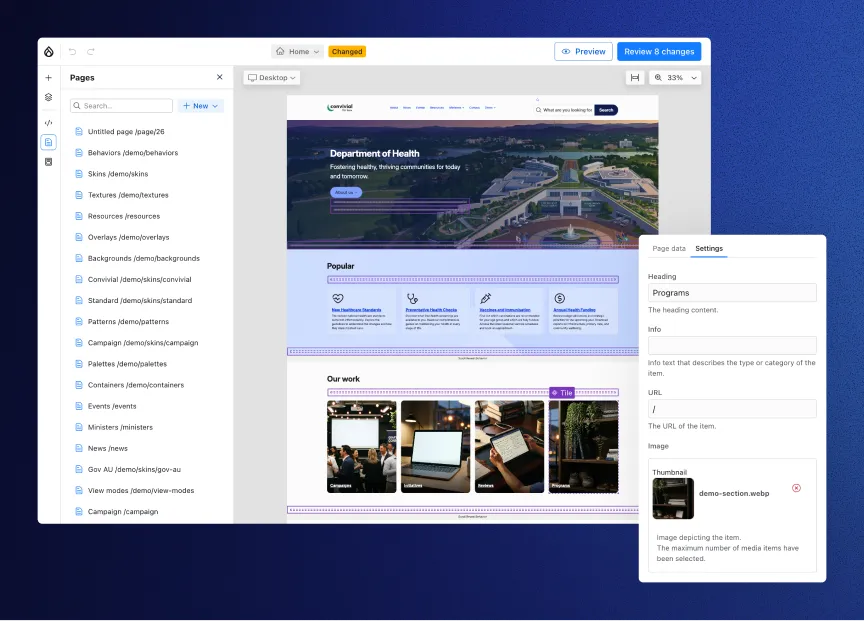
That changes the role of development. Developers focus on creating new capabilities and improving the platform, while marketers use those capabilities repeatedly to launch and adapt campaigns.
For a sophisticated marketing operation, that is a much stronger model than treating every new request as another website project. Drupal lets development build the marketing infrastructure once, then gives marketing more control over how quickly it is used.
Back to top2. Structured Content That Can Be Reused Everywhere
Where WordPress starts to become challenging
WordPress works naturally around pages, posts, and blocks. That model is effective until marketing needs the same information across multiple products, campaigns, websites, or digital channels.
Imagine a bank changes the minimum salary requirement for a loan. That information may appear on the product page, comparison pages, campaign landing pages, FAQs, and eligibility content. If each instance is managed separately, one product change becomes several updates, increasing the risk of outdated or conflicting information.
WordPress can support structured content through custom post types, fields, plugins, and development. But as products, relationships, and reuse become more complex, more architecture has to be added around the original publishing model, increasing time to market and technical debt.
Where Drupal excels
Structured content is one of Drupal’s core strengths. Instead of treating a loan, service, location, event, or product as another webpage, Drupal defines the information itself and how it relates to other content.
A financial product, for example, can include structured fields for:
- eligibility and income requirements,
- rates and fees,
- benefits and features,
- required documents,
- related products,
- and relevant FAQs.
Marketing manages that information once, then reuses it across product pages, comparisons, campaigns, applications, search, and other channels.
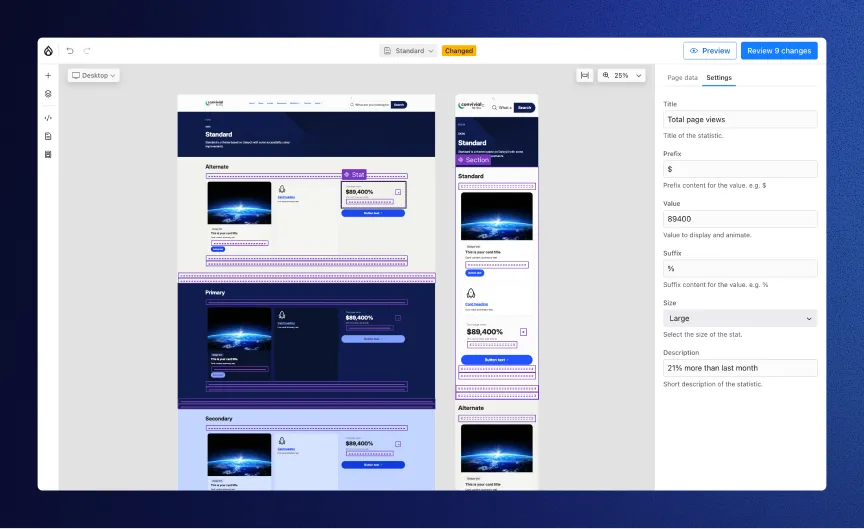
Because the underlying content model stays structured, teams can also introduce new components, redesigns, content types, and digital experiences iteratively without repeatedly rebuilding the foundation. This reduces technical debt and makes future enhancements faster to execute as the platform grows.
For marketing, the benefit is straightforward: one reliable source of information, faster change, and a scalable foundation that can evolve without becoming harder to maintain.
Back to top3. Reusable Components Without Losing Brand Consistency
Where WordPress starts to become challenging
For a small marketing team, WordPress page-building flexibility is often an advantage. The challenge becomes much more significant when that same flexibility is distributed across multiple brands, markets, departments, and agencies.
In an enterprise setting with several external agencies, dozens of landing pages, and multiple teams launching campaigns weekly, small variations quickly multiply. One team tweaks a hero for a campaign, another builds a new product card style, and an agency introduces its own CTA treatment. Over time, these small changes accumulate into a fragmented system of inconsistent components that drift away from the intended brand standard.
This creates more than a visual consistency issue. Marketing teams end up dealing with duplicated components and templates, inconsistent customer experiences, repeated design and development work, accessibility differences between implementations, and significantly higher effort whenever the brand evolves or changes.
Where Drupal excels
Drupal allows organizations to turn their design system into reusable, governed components. Developers and designers create approved building blocks once, while marketers use them to assemble new experiences without changing the underlying design rules.
A component library can include:
- heroes and promotional banners,
- product and service cards,
- forms and calls to action,
- comparison tables,
- testimonials and FAQs.
With Drupal Canvas, marketers can visually compose pages using these components while typography, spacing, accessibility, responsive behavior, and brand standards remain centrally controlled.
This makes campaign execution faster, but the larger advantage appears when something changes. A refreshed component, new brand treatment, or improved accessibility standard can be introduced at the component level rather than recreated across individual pages.
For marketing teams, Drupal creates a stronger balance between creative autonomy and brand governance. Teams can build and launch quickly, while the organization retains control over the system that keeps every experience consistent.
Back to top4. Better Workflows for Larger Marketing Teams
Where WordPress starts to become challenging
WordPress handles straightforward publishing roles well, with predefined roles such as Editor, Author, and Contributor, plus revisions for tracking changes.
The challenge appears when publishing becomes an enterprise process rather than a simple editorial task.
A financial-services campaign, for example, may need input from marketing, product, compliance, legal, and brand before it can go live. A public entity may have separate teams preparing Arabic and English content, with different reviewers and publishing authorities. An external agency may be allowed to create content, but not approve or publish it.
At that scale, basic roles are no longer enough. Teams need to know what stage content is in, who owns the next action, and who has authority to approve it. More advanced workflows can be added to WordPress, but they generally require extensions or additional development beyond its standard publishing model.
Where Drupal excels
Drupal includes Workflows and Content Moderation in core, allowing organizations to design publishing processes around how their teams actually operate.
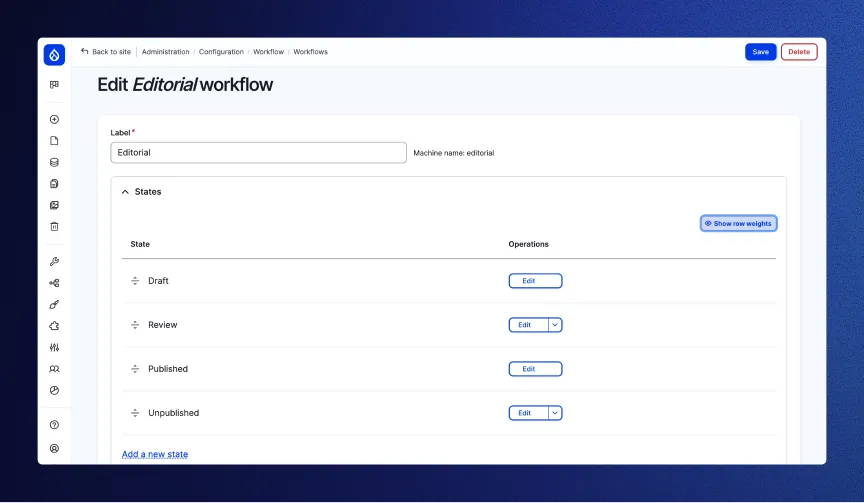
That gives marketing teams the ability to:
- create different approval stages for campaigns, products, news, or regulated content,
- assign specific permissions to marketing, product, legal, compliance, agencies, and regional teams,
- keep the current approved version live while a new version is still under review,
- apply different workflows to different types of content,
- and keep the entire approval history connected to the content itself.
A bank, for example, could let marketing prepare a product update, have the Product Owner verify the information, send it to compliance for approval, and only then make it available for publication. Simpler content, such as news or campaign updates, can follow a much lighter process.
This removes much of the approval process from email, spreadsheets, and messaging apps and brings it into the CMS where the content is actually managed.
For enterprise marketing teams, the advantage is not simply more workflow features. Drupal allows publishing governance to scale with the organization, giving teams more autonomy while keeping ownership, approvals, and accountability clear.
Back to top5. Centralized Control Across Multiple Sites and Teams
Where WordPress starts to become challenging
Managing one WordPress website is very different from managing a digital portfolio.
An enterprise may operate separate websites for different countries, brands, business units, products, or campaigns. As each site evolves independently, teams can end up using different themes, plugins, components, integrations, and publishing processes.
The cost is not just technical. Marketing starts duplicating work across the organization. The same component gets rebuilt for different markets, brand updates have to be rolled out site by site, and governance becomes increasingly difficult as more agencies and local teams get involved.
What started as several flexible websites can gradually become several separate technology environments that marketing has to coordinate.
Where Drupal excels
Drupal is particularly strong when multiple digital properties need to operate as part of one governed platform.
Organizations can centralize the capabilities that should remain consistent while still giving individual teams control over their local experiences. This can include:
- shared design systems and reusable components,
- common content structures and taxonomies,
- centralized security and technical standards,
- defined roles and publishing workflows,
- reusable integrations and platform capabilities.
Consider an organization entering a new market. Instead of starting another website from scratch, the marketing team can begin with an established Drupal foundation, then adapt the content, language, products, and campaigns to the local market.
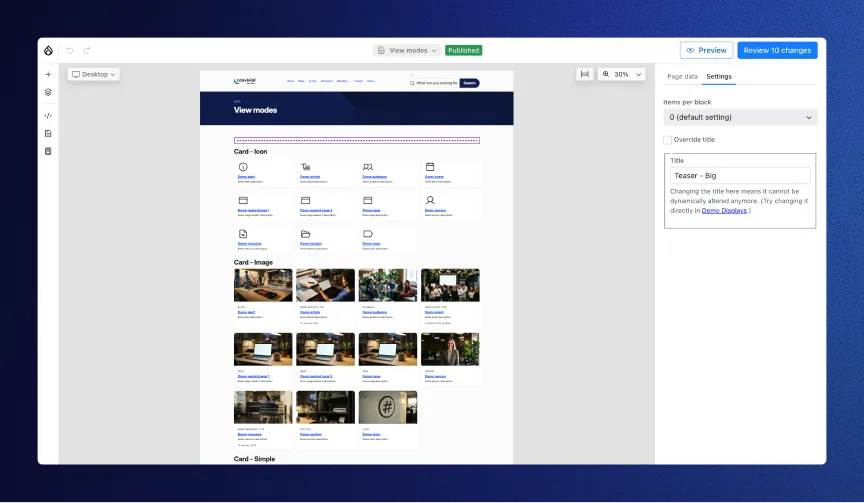
This is the model we implemented for Sela, a PIF company with a growing portfolio of entertainment destinations. Its Drupal multi-site foundation supports distinct brands and destinations, including BLVD City, BLVD District, and The Venue, while providing a platform that can accommodate new properties as the portfolio expands.
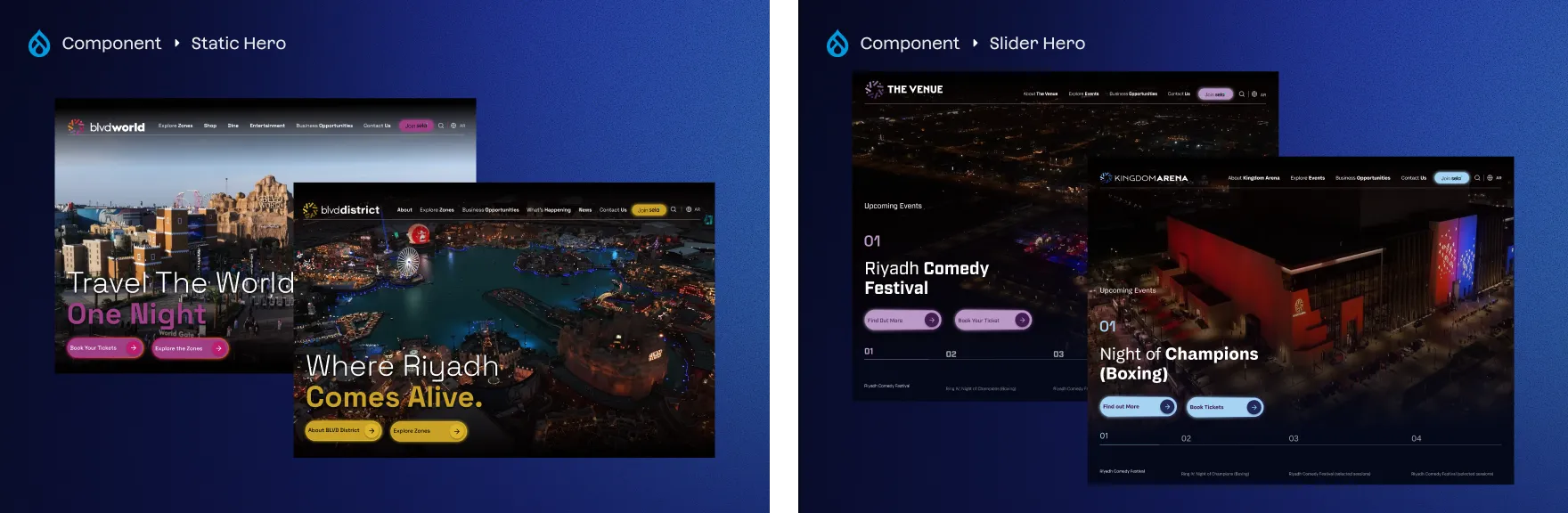
For enterprise marketing teams, that changes the economics of growth. A new brand, market, or website does not need to become another standalone technology project. Drupal allows the organization to reuse what it has already built while giving each team enough freedom to serve its own audience.
Back to top6. A Stronger Foundation for Marketing Automation and Integrations
Where WordPress starts to become challenging
WordPress can connect to CRMs, analytics platforms, email tools, and automation systems through plugins and APIs. The challenge appears when those connections become central to how marketing operates.
A lead-generation journey may need the website to capture a prospect, send the data to the CRM, trigger an automated campaign, identify the right product, and personalize what the visitor sees next. When each step depends on a different plugin or custom integration, marketing can end up with a collection of connections that work individually but become harder to govern as one ecosystem.
That creates more dependency on technical teams whenever a system changes, an integration breaks, or a new marketing requirement is introduced.
Where Drupal excels
Drupal is better suited to making the CMS part of a connected marketing architecture. Structured content and APIs allow products, services, offers, forms, and customer-facing information to be reused by other systems without creating separate copies for every channel.
That can support:
- CRM and lead-management workflows,
- marketing automation and campaign journeys,
- personalization and recommendations,
- mobile applications and customer portals,
- analytics and customer-data platforms.
Drupal also has an established marketing-automation ecosystem, including integrations with platforms such as Mautic, HubSpot, Marketo, and Salesforce. The Drupal–Mautic integration, for example, can connect website activity, forms, and content with automated marketing journeys.
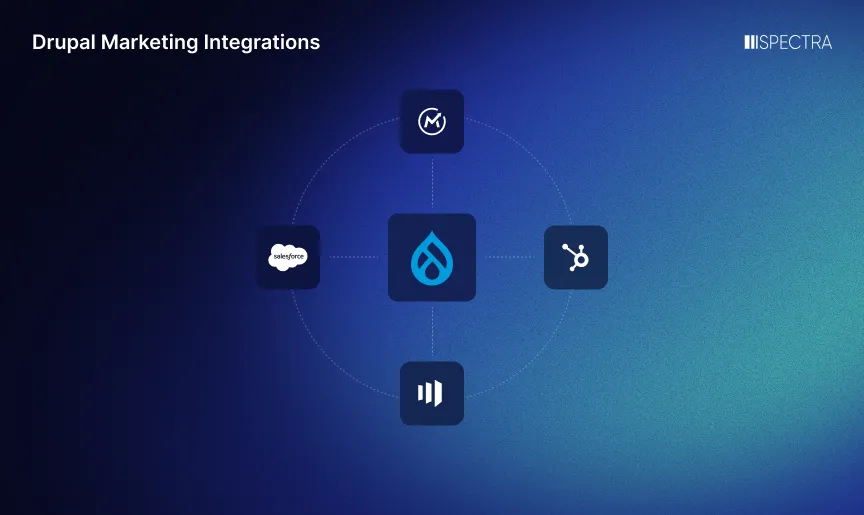
The bigger advantage is architectural. When product information, offers, services, and customer-facing content are already structured in Drupal, marketing tools can use that same information instead of maintaining another version inside every system.
For marketing teams, this creates a more scalable model: the CMS becomes the reliable content layer behind automation, personalization, lead generation, and customer experiences rather than another disconnected tool in the stack.
Back to top7. Better Prepared for AI-Driven Content and Discovery
Where WordPress starts to become challenging
WordPress is moving quickly on AI. Its Abilities API and MCP Adapter make plugins, themes, and core features discoverable by AI systems, a step toward a more agent-ready ecosystem. However, in critical environments, connecting AI to the CMS is only part of the challenge, the key question is what it can access, trust, and do with that information.
While WordPress can model structured content through custom post types, taxonomies, and fields, this must be carefully designed around its publishing-first architecture. In government contexts, where AI may answer questions on services, eligibility, documents, regulations, or procedures, the system must distinguish approved information from campaign content, respect permissions, and avoid surfacing outdated guidance as current policy.
At that point, AI readiness is less about adding an AI integration and more about content architecture, governance, and accountability.
Where Drupal excels
Drupal starts from a stronger foundation for critical environments. Structured entities and fields are fundamental to how Drupal models content, while its AI initiative is explicitly combining AI with governance, workflows, auditability, and human oversight. Drupal’s July 2026 AI strategy describes governance workflows and audit trails as part of the architecture rather than an afterthought.
For a government entity, that can support use cases such as:
- AI assistants grounded in approved public-service information,
- semantic search and RAG across services, regulations, FAQs, and official guidance,
- multilingual answers based on governed content,
- AI-assisted content creation that still passes through editorial approval,
- and AI agents that can act on the CMS while permissions and human oversight remain in place.
Drupal is also moving beyond AI as a writing assistant. Its current AI strategy separates AI used inside Drupal from external agents that can safely interact with Drupal, while Drupal CMS’s latest product strategy aims to make workflows AI-operable with humans kept in the loop.
For critical environments such as government, that distinction matters. WordPress is becoming increasingly capable of connecting AI to a website. Drupal is building toward an environment where AI can understand, retrieve, create, and act on governed information without bypassing the controls that protect its accuracy and authority.
Back to top8. You Don’t Have to Wait Until You’re an Enterprise to Choose Drupal
Where WordPress starts to become challenging
WordPress is often the default starting point for growing companies because it is familiar, quick to launch, and widely supported. That works well until the business starts adding more teams, products, workflows, integrations, and governance requirements.
The problem is timing. A company may choose WordPress when the website is simple, then spend the next few years adding plugins, custom content models, new approval processes, and increasingly complex integrations. By the time Drupal becomes an obvious fit, the organization is already facing the cost and disruption of re-platforming.
Where Drupal excels
Drupal is now deliberately making its enterprise foundation easier to adopt earlier.
Its 2026 product strategy says Drupal will maintain its enterprise leadership while regaining its position in the mid-market. It specifically identifies mid-market organizations, enterprise departments, growing businesses, and organizations with limited IT resources as priority users. (drupal.org)
That direction aligns with the market data we saw earlier. Drupal already has meaningful adoption outside the largest enterprises; the product strategy is now reducing the historical friction around starting with it.
Drupal CMS is doing that through:
- visual page building with Canvas,
- site templates and stronger defaults,
- faster setup and implementation,
- AI-assisted workflows,
- and an easier day-to-day experience for marketers.
Drupal now recommends Drupal CMS for most websites and positions it as enterprise-grade quality in a CMS that is easier to use, while Drupal Core remains available for more advanced implementations.
For a growing organization, this changes the decision. If you already expect your website to support multiple teams, structured content, integrations, workflows, or AI, you no longer have to treat Drupal as something you adopt only after you outgrow WordPress.
You can start with the architecture you expect to need later, without waiting for migration to become the price of growth.
Back to topShould Your Marketing Team Migrate from WordPress to Drupal?
A WordPress-to-Drupal migration should not start because Drupal has more capabilities. It should start when the way your marketing team operates has become more sophisticated than the platform supporting it.
One isolated problem is rarely enough. A slow campaign launch can be fixed. A plugin can be replaced. A workflow can be improved. The stronger migration case appears when several challenges start reinforcing each other.
Your team may be ready to evaluate Drupal if:
- marketers regularly depend on developers for routine changes,
- plugins and customizations are becoming harder to maintain,
- the same product or service information is duplicated across pages,
- several teams, markets, or agencies need different publishing permissions,
- approval workflows increasingly happen outside the CMS,
- multiple websites are difficult to govern consistently,
- CRM, automation, applications, or AI need reliable access to website content,
- redesigns and new features are becoming slower because of accumulated technical debt.
At this point, continuing to extend WordPress may solve the next request without solving the underlying problem.
Drupal changes that conversation. Instead of asking how to add another capability to the current website, teams can rethink the CMS as marketing infrastructure: structured content, reusable components, governed workflows, integrations, multisite management, and AI all built around a platform designed to keep evolving.
The migration decision should therefore be based on where the organization is going, not only where the website is today.
If your marketing operation expects more products, more markets, more teams, more automation, and stronger governance, the cost of staying on the wrong architecture can eventually become greater than the cost of changing it.
Back to topFinal Takeaway: Choose for the Marketing Operation You’re Building
The strongest CMS decision is rarely about what your website needs today. It is about what your marketing operation will need next.
WordPress remains a strong choice for simpler environments, smaller teams, and organizations that value speed and flexibility. Drupal becomes more compelling as the website starts carrying more responsibility across content, products, teams, markets, integrations, governance, and AI.
That is the pattern throughout this article. Drupal’s advantage is not that WordPress suddenly stops working. It is that Drupal is designed to absorb growing complexity without forcing the organization to rebuild the platform around every new requirement.
For marketing leaders, that creates a different way to think about CMS selection. The question is not simply whether you can launch the next campaign, page, or feature. It is whether the platform can keep supporting:
- more marketers without losing control,
- more content without creating duplication,
- more websites without fragmenting the brand,
- more integrations without adding unnecessary complexity,
- and more automation without weakening governance.
Drupal is also making that foundation easier to adopt earlier. Its growing mid-market focus means organizations no longer have to wait until they reach enterprise scale before considering a platform built for structured content, governed workflows, and long-term growth.
So the decision comes down to one question: Are you choosing a CMS for the website you have today, or for the marketing infrastructure your organization is building next?
Back to top